MORTAL GHOST and an interview with L Lee Lowe
 Lee writes rather fine short short stories on a blog (INTO THE LOWELANDS) and has now posted the first four chapters of a novel for young adults (YA), MORTAL GHOST. Every Friday there is a new installment and I find myself waiting for the next one with anticipation. There are two very well-drawn main characters and the story is developing nicely. Jesse seems to have a disturbed past, has powers of healing (well, almost-dead birds, at least), and now has met a girl called Sarah who seems to be feisty but a little naive. There have been scenes of much tension and also some beautifully described passages giving a vivid sense of place.
 Following in the wake of a new journal blog LOWEBROW, which hints at a life which involves some travel, Lee kindly agreed to answer some of my questions about MORTAL GHOST - as well as my usual run of questions about life in general.
CD: Why have you travelled around so much?
LLL: I never planned to spend more than half my life in foreign countries. Like so many things that happen to us, it just happened. Determined to become a poet (and undoubtedly under the influence of the exile generation of F. Scott Fitzgerald et al.) I went to Paris to study for a year after university and my first joblets. And one thing led to another, including two longish spells in Germany, where during the first one I met my spouse, and sandwiched in between, eighteen years in Zimbabwe.
But there is of course always a deeper reason for these life histories, and I’ve never stopped reflecting about my self-styled exile: not political, rather a need to be the outsider, the borderliner, perhaps the observer. I’ve decided that I need to write a novel about exile to work it all out for myself. It’s usually through fiction that I come a bit closer to self-understanding.

CD: Why are you interested in writing for young adults? What started off the interest?
LLL: I read very little YA literature as a teen – there wasn’t much of it, and I was more drawn to so-called genre fiction like SF and crime and romance, as well as the classics and a lot of poetry. Plenty of comic books too. And I’m not too proud to admit that I quite liked cereal packet and obituary reading as well. I had reasonably eclectic tastes, and to this day feel there are only interesting and less interesting books, books that are well-written and less well-written; not literary/non-literary ones. Whichever tools work. And throw out the rulebook! For each novel you forge the tools and make the rules you need for the particular challenge you’ve set yourself.
I really began to read and collect YA fiction at university. Adolescence is one of the most intense periods in a person’s life, and all teenagers are in some sense borderliners. Full of energy, full of doubts; full of sound and fury. Questioning, searching, rejecting. In YA lit circles it’s customary to speak of a search for identity – for agency – and while I agree that this is, in our cultural context, an essential part of the teenage years, at least ideally, I don’t like to set an age limit. Rather, I see it as a lifelong process: we all bear the infant, the child, the teenager within us.
That said, I find it’s the borders and crossing places which offer some of the richest soil for fiction.
And I don’t intend to write only for teens. Once I finish the YA novel I’m currently working on, I’m planning to do something quite different.
 CD: How long have you been writing?
LLL: Essentially, off and on since childhood, but in the early years, mostly poetry like so many beginning writers. And a lot of fiction which I never had the discipline to finish.
CD: Do you have other employment? What is it?
LLL: Over the years I’ve had the usual liquorice allsortment of jobs that often seems to be part of a writer’s training.
CD: Where did you grow up and where did you go to school and college?
What did you study?
LLL: I grew up on Long Island, in suburbs of New York City. BA in English lit and philosophy from a New York state university – sorry, no Harvard or Yale to vaunt – and an MA from a German university (Heidelberg).
CD: Whereabouts in Germany do you live now? Are you likely to stay
there?
LLL: In the hills above Bonn, near the Rhine River. Will I stay? Probably not.
CD: What initiated MORTAL GHOST? How much of this have you written already? How long is the finished work?
LLL: Initiated? A single image – a dream sequence – which became the first sentences of the first draft, long discarded. The novel is finished but needs certain revisions which I’ve planned but will undertake as the serialisation progresses. There are also certain scenes which I cut from the much longer original version and which I may decide to restore in one form or another. As it now stands, it’s about 350 pages in length.
 General Questions.
CD: Do you have any connection with snails?
LLL: We have a large garden, and in my feeble attempts to grow vegetables organically, I tried the method local gardeners here swear by to rid themselves of the seasonal slug infestation – beer traps (what else in Germany?). Unfortunately, though slugs and snails love the beer, and do crawl in to drown, we couldn’t understand why the plastic saucers were always empty. Until we discovered our dog Gypsy cheerfully draining the traps, slugs and all.
CD: What is your proudest moment?
LLL: No one single moment, many small ones regarding my children. As for myself, I don’t think pride is something which comes readily.
CD: Have you ever had a life-changing event - if so what was it?
LLL: The nearest I’ve come, was the suicide of my closest friend’s 15-year-old son several years ago. He’s the Jake to whom MORTAL GHOST is dedicated.
 CD: What is the saddest thing you’ve ever heard of or seen?
LLL: Many in Africa: the first newborn who died of tetanus, the toddler daughter of a staff member badly burnt by an unattended paraffin lantern she overturned on herself, my own five-year-old daughter’s discovery of an abandoned newborn baby in a ditch next to our house, the disabled kids who could have avoided polio with simple vaccinations, the street kids, the hungry, the whole generation lost to AIDS. But you don’t have to go to Africa for sadness, it’s an integral part of life.
CD: If there was one thing you’d change about yourself what would it be?
LLL:Only one allowed? I’ve got a whole list. Ten years ago it probably would have been to rid myself of my terrible temper. Now it would be a greater gift for writing.
CD: What is happiness?
LLL: There’s no such thing. There are only happy moments.
CD: What is the first thing you do when you get up?
LLL: Pee and tea.
posted by Clare Dudman at 11:31 am


16 Comments:
this is a very interesting interview. and i like the part at the very end when he says "pee and tea", that could be me, except that it's coffee. don't we all have fiction hiding somewhere that we didn't have enough discipline to finish?
Great interview, an interesting interview from a very interesting person. Thank you!
You always ask great questions! I wish more authors would right good books for teenagers. There is a gap and it can diminish the love of reading.
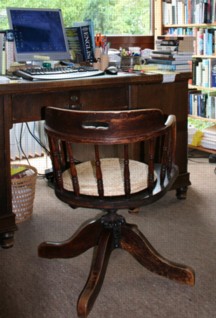
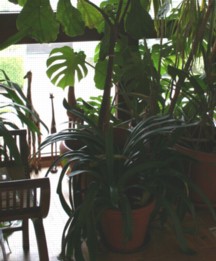
A very interesting interview, Clare, with an appealing personality. I admire Lee's unaffected responses and find that she comes across as a very likeable person. The pictures - are they of Lee's home or yours? I love the office and the plants! Looks like home to me, or what home will ideally become if our never-ending renovation is ever completed.
I'm glad you all found what LLL had to say so interesting - I did too. LLL claimed not to have had an interesting life, at first but I suspected that wasn't true.
No Susan, the house is not mine - I only wish it were. My place is much more untidy.
I am almost speechless at the pictures. What an absolutley lovely study! And what a place to write! It is truly beautiful, and no doubt the place of production of many beautiful words!
Great to hear LLL's replies also. Good to see the author behind the words. Congrats to both interviewer and interviewee!
Very interesting interview - thanks for posting it!
Very, very interesting interview with LLL. I had no idea! No wonder!
(Lee, when was the last time you were on Long Island? I'm on Long Island right now!)
Here's to Gypsy. Bottoms up!
Lynne AKA The Wicked Witch of Publishing
Thnaks for ann extremely well-conducted interview! I have been reading Mortal Ghost too and enjoying it - I must get back to Lee with feedback.
A fascinating insight into the mind of the writer behind Mortal Ghost. I to have been following the story and enjoying it. Thanks very much indeed!
Great interview! Love the story about Gypsy and the beer.
And the photos! My God, the photos . . . .
Very nice interview - thanks! I posted a link to it on Finding Wonderland: The WritingYA Weblog.
It was also interesting to read about your Patagonian travels. I heard a good presentation this summer about the Welsh colony in Patagonia from someone who did fieldwork there, and it sounds like a very worthy endeavor to try to preserve the Welsh language and culture there. I hope to travel there someday!
Great interview. Thank you.
Wow, I love your story Mortal Ghost, I have podcasted all 32 chapters and listened to them in one day (wouldnt be able to tell you if my life depended on it what occurred at uni today though) I love the story, not only is it magnificently written but the reader (who I think I may have fallen in love with -well his voice anyway) has such a perfect voice for this role. And, if I wasn't a broke uni student I would donate or buy or whatever it is to support your book. Instead I am offering to do any computer work (I noticed you may need some help with your website - I can help with that I finished my course last year). Jesse is such an amazing character, I cant wait for the next podcast. Still debating whether to 'read' on or wait to hear the soothing voice.
Love the interview too!
~Dani
Hi Dani, thanks so much for the comment. Would you mind emailing me privately?
Lee
(Clare, apologies for posting here, but I'm hoping Dani will check back.)
I'm surprised that no one has offered LLL a publishing contract for this book. It seems to be very popular with a number of people.
Did I miss something?
Post a Comment
Comments are subject to moderation.
<< Home